Blog
Indian Cake Design: How Culture Becomes Cake
9 October 2026 · 13 min read
A three-tier cake. The bottom tier is blue, the middle one yellow. On top sits an earthen pot, tipped onto its side, white butter spilling from the mouth of it. A gold flute lies across the blue tier with a tassel hanging off one end. Two peacock feathers lean against the yellow tier. An ornate gold-framed medallion sits on the blue tier, empty, where the child's name goes.
Anyone who grew up in India knows who that cake is about within a second of seeing it.
Now notice what is not on it.
There is no face. No figure. No deity. Five objects and two colours do the whole job — the blue of Krishna's skin, the yellow of his pitambar, the matki he stole butter from, the bansuri he played, the peacock feather in his hair.
That cake is the whole argument of this article about Indian cake design, already finished and sitting on a board.
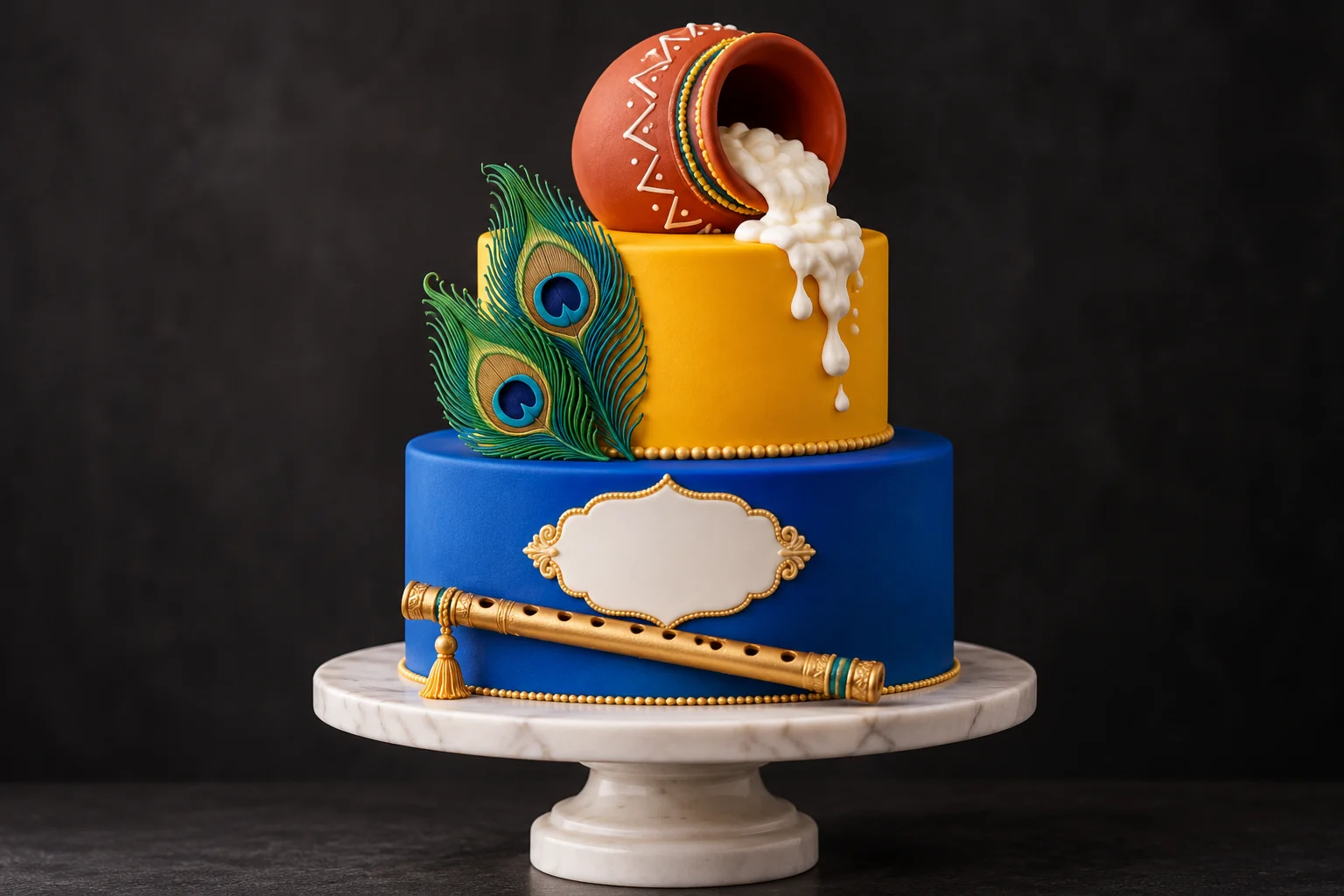 Krishna, assembled entirely out of his belongings. The name goes in the medallion — which is exactly where a portrait would have gone.
Indian cake design is in an interesting phase, and it is not the phase people usually describe. The common version of the story is that Indian elements are appearing on cakes — a motif here, a traditional flavour there. That has been true for years and it is not very interesting.
The interesting part is how they are being translated, and the fact that the best work is getting less literal rather than more.
1. Krishna cake design, without showing Krishna
Start with the translation problem, because it is the one with the sharpest edges.
Indian culture offers an enormous library of recognisable things. A diya. A matki. A mehendi pattern. A rangoli. A saree border. A temple arch. Any of them can be put on a cake. The question a designer actually faces is which part of the reference carries it, and how little is enough.
On that Krishna cake, the answer was: colour and belongings. The baker never attempted the figure.
That is partly an aesthetic choice and partly a careful one. In many Indian households, putting the image of a deity on something that is then cut with a knife and eaten is uncomfortable at best. It is a real constraint, and bakers who work with religious themes run into it constantly.
What makes the cake above worth studying is that the constraint produced a better design rather than a compromised one. A printed Krishna face would have been easier, cheaper and less memorable. Working around it forced the baker to find the five objects that do the job without the figure — and those five objects are more fun to look at than a portrait would have been.
The same move works almost everywhere once you see it.
- A diya can become the form of a cupcake rather than a picture on one.
- A rangoli can become the geometry of a buttercream top, not a transfer sheet.
- Mehendi can become the linework itself, piped rather than printed.
- A saree can set the colour, the drape and the surface texture of a whole tier.
- Jewellery can drive the metallic sugar work rather than sit on top as a topper.
Call it symbolic translation: take the culturally recognisable thing, and find the edible expression that is nearest to how it was actually made.
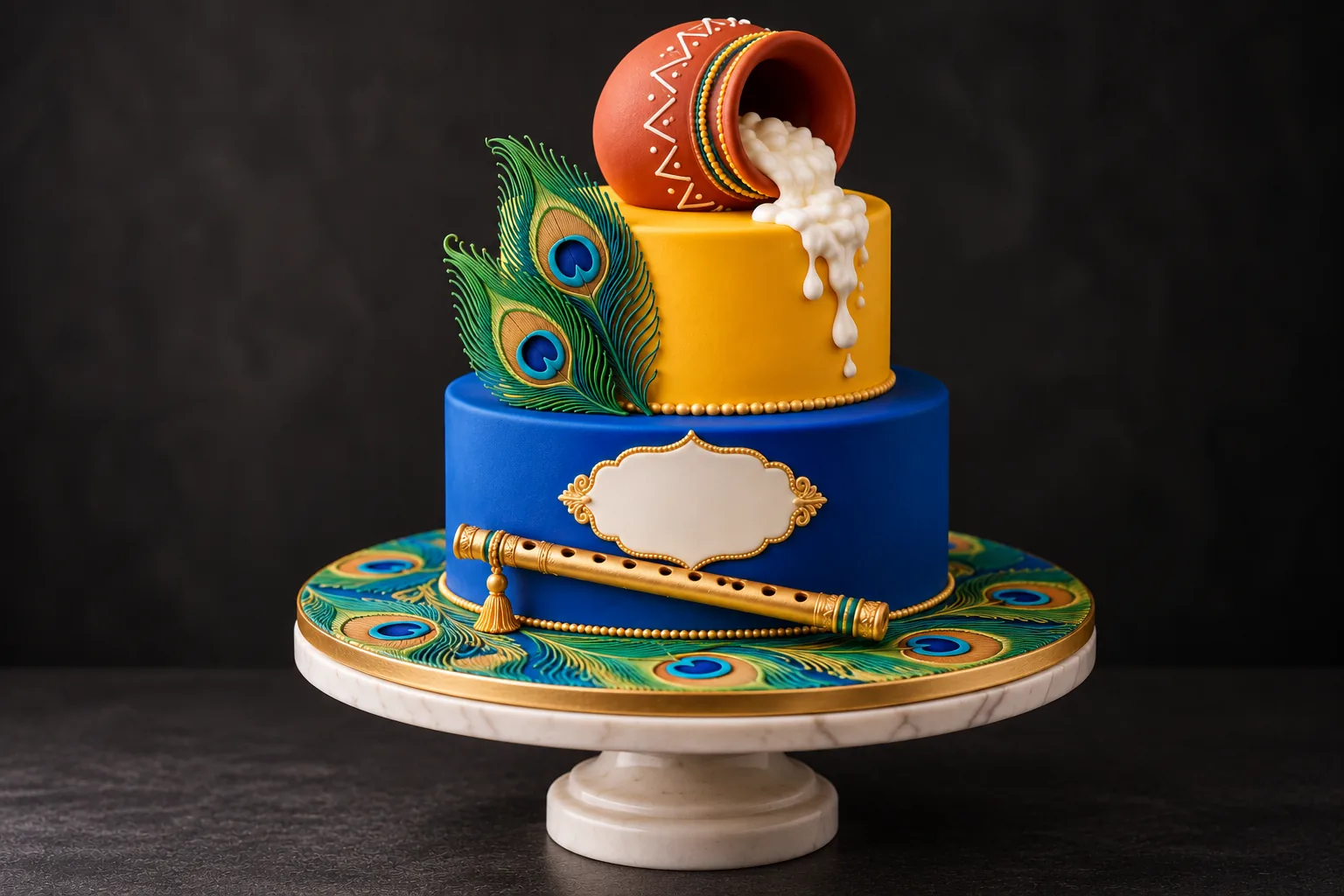 The same vocabulary, used again. Here the board itself is painted and the flute rests on it, which pushes the scene out past the edge of the cake.
2. Why Indian cake design is changing now
Worth being honest about what can and cannot be proven here.
For roughly two decades, the aspirational cake at an Indian wedding or a milestone birthday looked Western — white, tiered, fondant-smooth, borrowed wholesale. Indian references were what you added to a cake, not what the cake was.
That is visibly reversing, and two things seem to be behind it.
The first is discovery. Research on the Indian cake market from TechSci Research names Instagram and Pinterest directly as the platforms that drive which designs people find and then ask for. When the reference board a customer arrives with is full of Indian cakes rather than English ones, the brief changes on its own.
The second is simply that the people commissioning these cakes have changed. A customer who grew up seeing the Western tiered cake as the premium option is now specifying something that looks like their own house. That is an observation rather than a finding — nobody has measured it — but it is consistent with what the market research describes as a move toward customisation and toward fusion and regional flavours.
3. Indian flavours in modern cakes: rasmalai, paan, kesar pista
Before any of the visual work, the fusion happened in the mouth.
Rasmalai, gulab jamun, peda, gajar halwa, paan, kesar, pista, cardamom, rose — these are flavours an Indian customer already has a complete memory of. A baker does not have to teach anyone what a rasmalai cake should taste like, which is a large head start.
The useful version of this is not "put mithai on a cake".
It is to ask what the sweet is actually made of, and bring that into the cake's structure:
- Rasmalai → a milk-soaked sponge, cardamom, saffron, rose. The soak is the point.
- Gulab jamun → caramelised milk solids and a syrup that has to be balanced against an already sweet crumb.
- Paan → betel leaf and gulkand, which bring a cooling finish that most cakes have no equivalent for.
- Kesar pista → saffron and pistachio, and a colour that comes from the ingredients rather than from a bottle.
- Kaju katli → almond-cashew richness, geometric form, and vark — the edible silver leaf that mithai shops have used for generations and that transfers onto cake without any adaptation at all.
- Gajar halwa → carrot, cardamom, nuts and warm spice, which is already most of the way to a carrot cake and tends to surprise people by how well it travels.
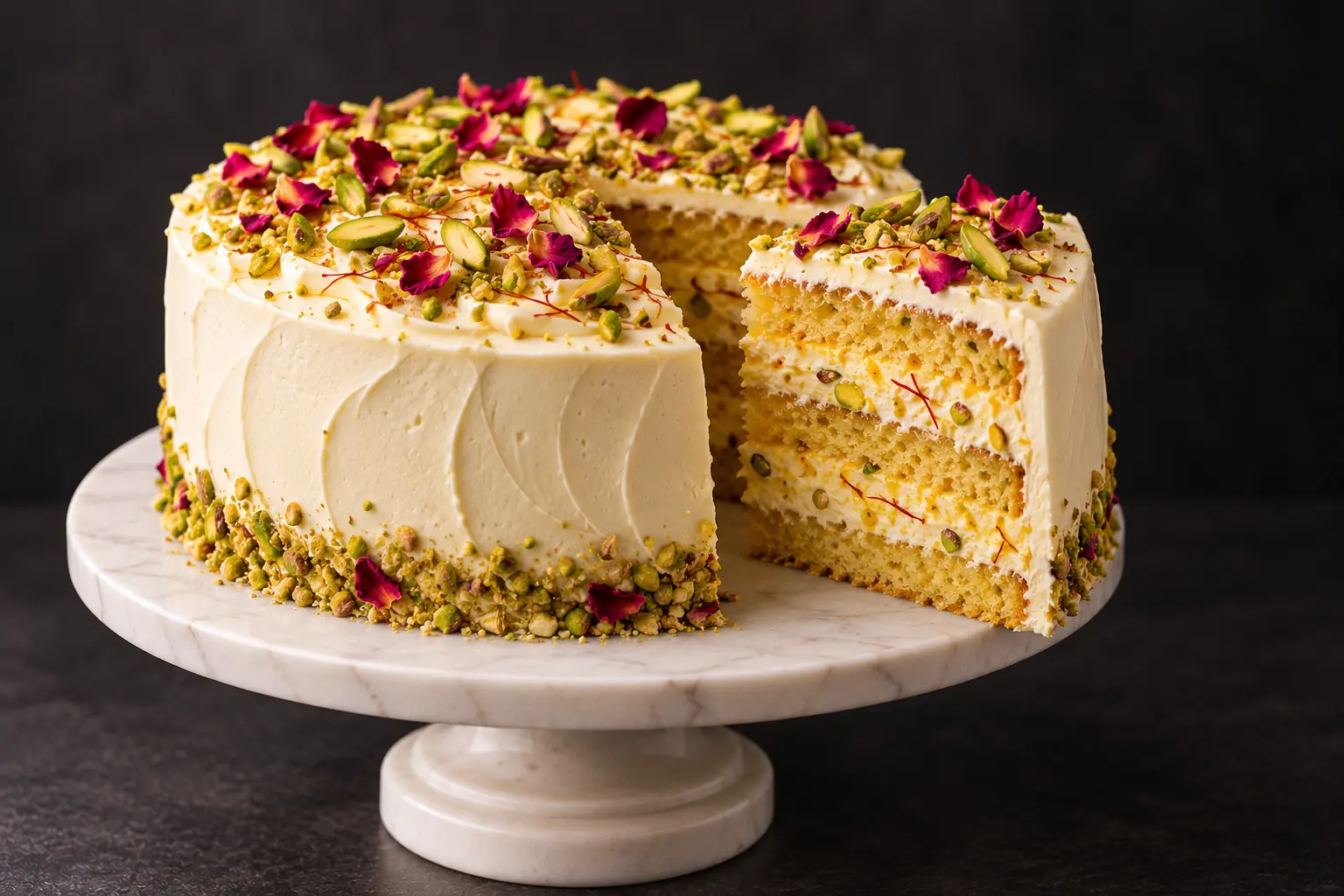 The sweet taken apart and rebuilt as structure: the milk soak, the cardamom cream, the saffron and the pistachio all doing the same job they do in the bowl. Nothing sits on top as a garnish.
The reference stays familiar. The format changes. That is the whole trick, and it is the same trick the visual work uses.
4. Mehendi, rangoli and textile patterns as cake decoration
India's crafts are the hardest and most rewarding thing to translate, because none of them were made of sugar.
Mehendi is a cone of paste on skin. Piping is a cone of icing on fondant. The tool is almost the same, the gesture is almost the same, and the line quality a mehendi artist spends years developing transfers to a piping bag more directly than most techniques transfer to each other.
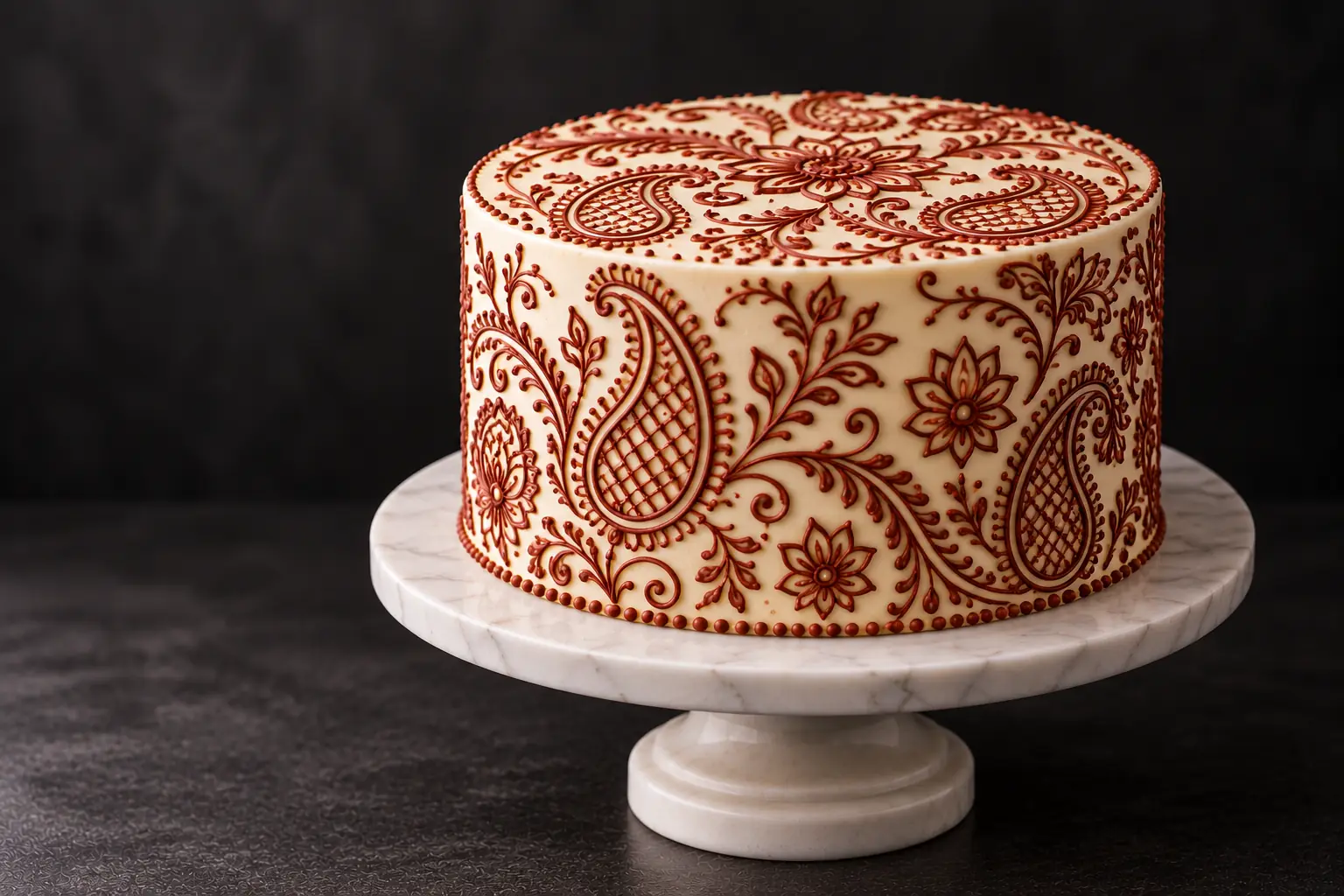 Two colours and one bag. The lattice inside the paisleys is the tell — that is a hand that has drawn this pattern many times before, on skin.
Rangoli and kolam are laid down in powder, as geometry, from the centre out. A buttercream top is a circle worked from the centre out. Textile patterns become fondant embossing, edible print or hand-painting. Architectural ornament becomes royal icing, modelling chocolate or sugar structure.
The original material changes. The design language survives the move.
This is also where the globally developed techniques come in, and it is worth saying plainly that they do not have to be Indian for the result to be. Lambeth over-piping is a 1930s English method. Applied to the ornament on a jewellery box or a temple arch, it stops reading as English almost immediately. The technique is a vocabulary; the reference decides what gets said with it.
5. Indian architecture as cake: royal icing at scale
Indian architecture scales this up as far as it will go.
Pune-based cake artist Prachi Dhabal Deb, who works in royal icing and is known for it, built a 200 kg edible Indian-inspired palace in vegan royal icing — ten feet long and nearly five feet high — which entered the World Book of Records, London. It followed a 100 kg royal icing version of Milan Cathedral in 2022.
Two details from that are more interesting than the weight.
The first is the vegan royal icing, which she developed specifically for Indian clients. Conventional royal icing is built on egg white. A large share of the customers commissioning a temple, a palace or a wedding centrepiece in India are vegetarian, and plenty of the occasions themselves are. The recipe is not a nutritional footnote — it is what makes the technique usable for the occasions it is most suited to.
The second is that at this size, the discipline stops being decoration:
architecture → cake structure. Stone ornament → piped royal icing. A building → an edible sculpture.
6. Indian wedding cake design: the references already exist
An Indian wedding is the one job where a baker is almost never designing from scratch, and that changes the work in a way worth naming.
By the time the cake is ordered, everything around it has been settled for months. The lehenga exists. The decorator has a palette. The invitations went out with a motif on them. The mandap has a structure. The baker is the last vendor in, and the brief is really a question of which of those threads to pull into sugar.
That sounds like a constraint. It is closer to a gift.
The embroidery on a blouse can be piped — and unlike a mood, it can be photographed, measured and matched. A gold zari border has an actual width. The invitation's motif can be embossed into fondant at the size it was printed. The venue's florals can be repeated in sugar, in the same varieties.
The references are physical objects, so both people can look at the same thing. A customer can put the fabric on the table. That is a completely different conversation from "something traditional, but modern" — and it is why wedding work, for all its scale, often goes more smoothly than a single-tier birthday cake with a theme nobody has pinned down.
The one trap is the opposite problem: pulling in all of it. A cake that answers the lehenga and the mandap and the invitation and the florals is four cakes fighting each other. The same discipline that left Krishna's face off applies here — pick the two threads that carry the wedding, and let the rest go.
7. What an Indian-themed cake actually costs the baker to make
Most writing about this subject stops at the aesthetics. The bakers doing it do not have that luxury, and any honest account has to include the parts that are hard.
Fondant and Indian weather are enemies. The smooth, saturated fondant finish this style depends on sweats in humidity and softens in heat. A cake that looked immaculate in an air-conditioned kitchen can be visibly tired after forty minutes in a car in May. Much of the craft in Indian fondant work is really logistics — chilled transport, assembly on site, and knowing which finishes will survive the journey.
Deep colour is a technical problem, not a choice from a chart. The reds, blues and yellows this vocabulary needs sit at the far end of what gel colour can do. Getting there takes enough colour to affect taste, and the deeper shades bleed into neighbouring fondant over hours. The blue tier on that Krishna cake is a harder piece of work than it looks.
Royal icing wants dry air. It is brittle, it needs to cure, and a monsoon week will simply take a structure away from you. Large royal icing work in India is as much a calendar decision as a design one.
Sugar flowers and feathers are slow. The peacock feathers on those cakes are made, not bought — wired, shaped, painted and dried, usually days ahead. A real feather is not food safe, so there is no shortcut available. That time has to be in the price, and explaining why is its own conversation.
None of this is a reason to avoid the work. It is the reason the work is worth something, and it is the part a customer comparing two quotes cannot see.
8. What the market research on Indian cakes actually says
Two things can be said with a source behind them.
TechSci Research's work on the Indian cake market identifies customisation and personalisation as a major trend — themed designs, photo cakes, character cakes, wedding cakes, made to order — and identifies Instagram and Pinterest as significant to discovery. The same research identifies fusion and regional flavours as an emerging trend, with traditional Indian flavours moving into modern cake formats.
Puratos' Taste Tomorrow research, which covers consumers across 50 countries, found that 64% of people globally agree food that looks good is tasty too, and that 24% say they will pay more for products that showcase craftsmanship.
Neither of those is about Indian cultural cake design specifically, and it would be dishonest to present them as if they were. What they describe is the environment this is happening in: appearance and visible craft increasingly decide how people judge a premium bakery product.
Anything beyond that — how big this movement is, how fast it is growing, which references sell best — does not currently have public data behind it worth quoting.
9. The hardest part of an Indian themed cake is the brief
Here is where this runs into the thing that actually goes wrong.
A culturally specific cake is much harder to commission than a generic one, and the difficulty is not in the baking.
When a customer asks for a Frozen cake, both people are picturing the same film. When a customer asks for "something Krishna-themed, but tasteful", they are picturing a cake from their own childhood, their own region, their own family's version of the story — and the baker is picturing a different one. Both of them think the conversation went fine.
The gap only becomes visible at delivery, which is the worst possible moment for it to become visible.
This is the real reason the symbolic approach matters commercially and not just artistically. Agreeing on five objects and two colours is something two people can genuinely do in advance. Agreeing on a mood cannot be done at all.
So the useful question for this movement is probably not how to make Indian cakes more elaborate. India has never been short of visual material, and the bakers are not short of skill.
It is how a customer and a baker, each holding a different picture in their head, can arrive at the same cake before anyone turns on the oven.
That problem is not specific to Indian references. It is the central difficulty in all custom cake work, and we have written about it at length in how cake design became a form of storytelling.
Common questions about Indian themed cakes
What is an Indian fusion cake? A cake that takes an Indian reference — a flavour, an object, a pattern, a craft — and expresses it through contemporary cake technique rather than reproducing it literally. A rasmalai cake is a fusion cake in flavour; a cake that carries a mehendi pattern as piped linework is one in design. The reference stays recognisable, the format changes.
Can you put Krishna on a cake? You can, but many Indian families would rather you did not, because the cake is then cut and eaten. The common solution is to evoke the deity through associated objects and colours instead — the matki, the bansuri, the peacock feather, blue and yellow — which is what the cakes shown in this article do. It is worth asking the customer directly rather than assuming either way, since practice varies widely between families and regions.
Which Indian flavours work best in a layered cake? The ones whose structure survives the move. Rasmalai works because a milk soak is already how you keep a sponge moist. Gajar halwa works because it is close to a carrot cake already. Kesar pista brings its own colour. Paan is the most divisive and the most memorable. Gulab jamun is the hardest to balance, because the syrup lands on a crumb that is already sweet.
Does fondant work in Indian weather? It works, but it has to be planned around. Fondant sweats in humidity and softens in heat, so a cake that looked immaculate in an air-conditioned kitchen can be tired after forty minutes in a car in May. Bakers who do this routinely rely on chilled transport, assembly on site, and finishes chosen for the journey rather than the photograph.
What should I bring to a baker for an Indian themed cake? Objects, not adjectives. A photograph of the lehenga, the invitation, the fabric swatch, the specific sweet you want it to taste like. "Traditional but modern" means a different cake to every person who hears it. Five concrete references beat a paragraph of mood every time.
A new vocabulary, not a new decoration
Indian cake design does not have to choose between traditional and contemporary.
India supplies the flavours, patterns, objects, materials, architecture and crafts. Contemporary technique supplies the medium. The baker does the translating, and the translation is where all the judgement lives — what to keep literal, what to abstract, what to leave out entirely.
The strongest work is rarely the most faithful. It is the work that takes something completely familiar — a diya, a matki, a mehendi line, a sweet everyone has eaten since childhood — and makes you look at it again because it has turned into cake.
Which is the difference between putting Indian culture on a cake, and designing with it.